

Medication Errors – Part 2: What Your Pharmacy Team Will Do
This newsletter is part 2 of a 2-part series on medication errors. Part 1 describes the actions that you, the consumer, can take when a medication error occurs. Part 2 describes what to expect from your pharmacy team.
Volume 17 • Issue 7 • Part 2
Medication errors can happen in different ways and include getting the wrong drug, getting the wrong dose of a needed drug, receiving a medication by the wrong route, or unclear instructions. Many errors do not cause harm, but some can be serious.
If you think there has been an error with your medication, let your pharmacy team know right away. When you contact your pharmacy to report an error, and it’s confirmed that a mistake has happened, you can expect them to take the following steps:
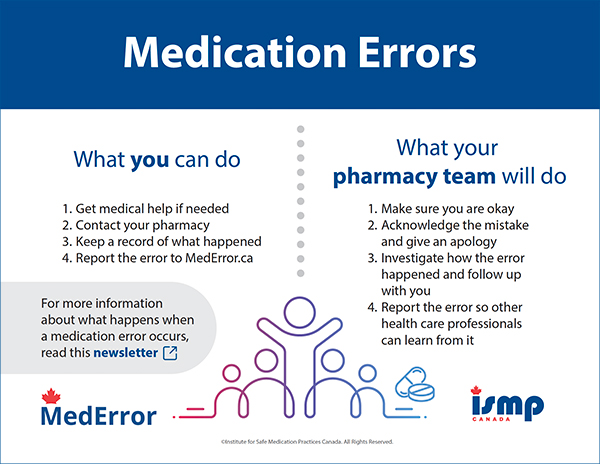
1. Make sure you are ok.
- They will ask you questions, for example, how much of the medication you might have taken and if you are having any unwanted symptoms.
- The pharmacist will help guide you through what happens next, which might include a change in medication, informing the prescriber, and/or additional medical care.
2. Acknowledge the mistake and give an apology.
3. Investigate how the error happened and follow up with you.
- Understanding how the error occurred will lead to safety changes in the pharmacy.
- The pharmacy may ask you to share your ideas about how to prevent a similar error in the future.
- In many cases, the pharmacy will tell you what they found and share their plans to prevent the same error from happening again.
4. Report the error.
- Depending on the province, the pharmacy may be required or encouraged to report the error to ISMP Canada.
- ISMP Canada creates Safety Bulletins and other resources to help health care providers learn from reported errors and improve medication safety.
Download the safety resource Medication Errors – What Your Pharmacy Team Will Do
—
MedError newsletters are reviewed by consumers who are committed to improving medication safety. Learning from consumer reports is shared with health care providers through ISMP Canada publications. This newsletter shares information about safety medication practices, is noncommercial, and is therefore exempt from Canadian anti-spam legislation. *Funding support provided by Health Canada. The views expressed herein do not necessarily represent the views of Health Canada. Mederror is a component of the Canadian Medication Incident Reporting and Learning Prevention System (CMIRPS).